
A child’s dental abscess is a pocket of pus that forms in or around an infected tooth. A bacterial infection causes it and, if left untreated, can become a serious oral health problem. The good news for low-income families is that Medicaid coverage through AHCCCS pays for the emergency dental care that can stop an abscess in its tracks.
The earlier you spot and treat a tooth abscess in your child, the simpler the treatment will be. Dental abscesses often start as untreated cavities that have progressed for too long. In this blog post, we will cover what you need to know about a child’s dental abscess, including:
- The dental abscess stages of how a tooth infection develops
- What to do right away if you believe your child has a dental abscess
- Dental treatment options for abscesses (typically, an extraction)
- How Medicaid coverage can help you afford pediatric treatment if your child has a tooth abscess
Your child’s pediatric dentist is a valuable partner in helping you minimize the risk that your child will ever know what a child tooth abscess feels like. At the Kids’ Dental Office of Phoenix, our team of child dentists helps parents like you give their children the preventive dental care they need to avoid tooth decay whenever possible and treat it early if it occurs.
If you live in the Phoenix area and think your child might be developing a tooth abscess, call us right away at (602) 903-4894, or reach us online to ask a question or schedule a prompt appointment.
Kids Dental Abscess Stages
A tooth abscess is the result of a multi-stage process that begins as simple tooth decay but steadily worsens the longer it is left untreated. Here are the stages to look for.
Stage One: Tooth Enamel Decay
The outer enamel layer is the tooth’s primary defense, but it needs protection itself through regular brushing and flossing, coupled with routine checkups and dental cleanings.
When the enamel is exposed for a prolonged period to food debris, bacteria in your child’s mouth feed on that matter. The waste byproduct of this bacterial growth is plaque. Plaque contributes to the breakdown of tooth enamel by creating small pits in the tooth surface. Sometimes you can see this damage as brown or white spots on your child’s teeth.
As long as the enamel remains intact, your child may not experience any physical sensations like pain, even though tooth decay has already begun in the form of one or more cavities. At this stage, dental treatment options are simple, such as cavity fillings or a fluoride-based enamel sealant.
Stage Two: The Decay Penetrates the Enamel and Reaches the Dentin Layer
Underneath the enamel lies the next level of your child’s tooth structure, a softer yellow layer called dentin. The dentin structure includes tiny tubes that lead to the nerves inside the tooth.
Once tooth decay has reached the point where the dentin is exposed to infection, you will often see your child experiencing the first signs of oral discomfort in the form of mild pain or sensitivity to hot and cold foods and beverages, and to sweets. Your child may wince when eating or start to favor one side of the mouth when chewing food as a natural response to this minor pain.
At this point, dental treatment is usually a cavity filling to stop the dental infection from penetrating even further into the tooth down to the nerve level. Your child’s dentist will remove the decayed parts of the tooth and replace them with a durable filling material. At advanced stages of tooth decay, a dental crown may be needed.
Stage Three: Pulp Infection
Beneath the dentin layer is the soft inner core of the tooth that contains its blood supply and the nerve of the tooth. This is called the pulp, and when a bacterial infection reaches this level, the condition is called pulpitis.
At this point, your child’s pain symptoms will become readily noticeable:
- He or she will likely experience a persistent and often intense toothache even when not eating or drinking.
- The tooth will become sensitive to touch or to pressure, and eating or drinking hot or cold foods or drinks will intensify the pain.
- The pain will often get worse at night or when lying down.
- You may see signs of gum disease, such as gum swelling or red gums.
Once the infection has reached this stage, cavity fillings are no longer effective as treatment. There are three main ways a pediatric dentist will address pulpitis, depending on how far the infection has spread inside the tooth:
- Pulpotomy. If the infected pulp is confined to the crown of the tooth (the part above the gumline), your child’s dentist can perform a pulpotomy. This procedure removes only the infected pulp from the crown, leaving the healthy pulp in the roots intact. A stainless steel crown is usually placed afterward to protect the remaining tooth.
- Pulpectomy (baby root canal). If the infection has spread down into the roots, your child’s dentist may need to perform a pulpectomy, often called a baby root canal. In this procedure, all of the pulp tissue is removed from both the crown and the roots, and the tooth is then cleaned, sealed, and capped with a stainless steel crown.
- Extraction. In severe cases where the tooth cannot be saved, the infected tooth may need to be pulled.
Treatment at this point often includes prescribed antibiotics, typically amoxicillin (or azithromycin if your child is allergic to penicillin).
Stage Four: Abscess Formation
If a tooth infection reaches this level, it has spread beyond the tip of the tooth’s root, and a pus-filled pocket has formed in the gum or jaw area around the affected tooth. This is a reaction of your child’s immune system to an infection that has spread beyond the tooth itself.
By this advanced stage, it will be hard to be unaware of your child’s symptoms:
- He or she will be experiencing constant, severe, throbbing pain that has spread to the jaw or the face.
- You may see the abscess in the form of a swollen, yellowish bump on the gum, which may be oozing pus or fluid.
- Your child will often experience persistent bad breath (halitosis) or a bad taste in his or her mouth even after brushing.
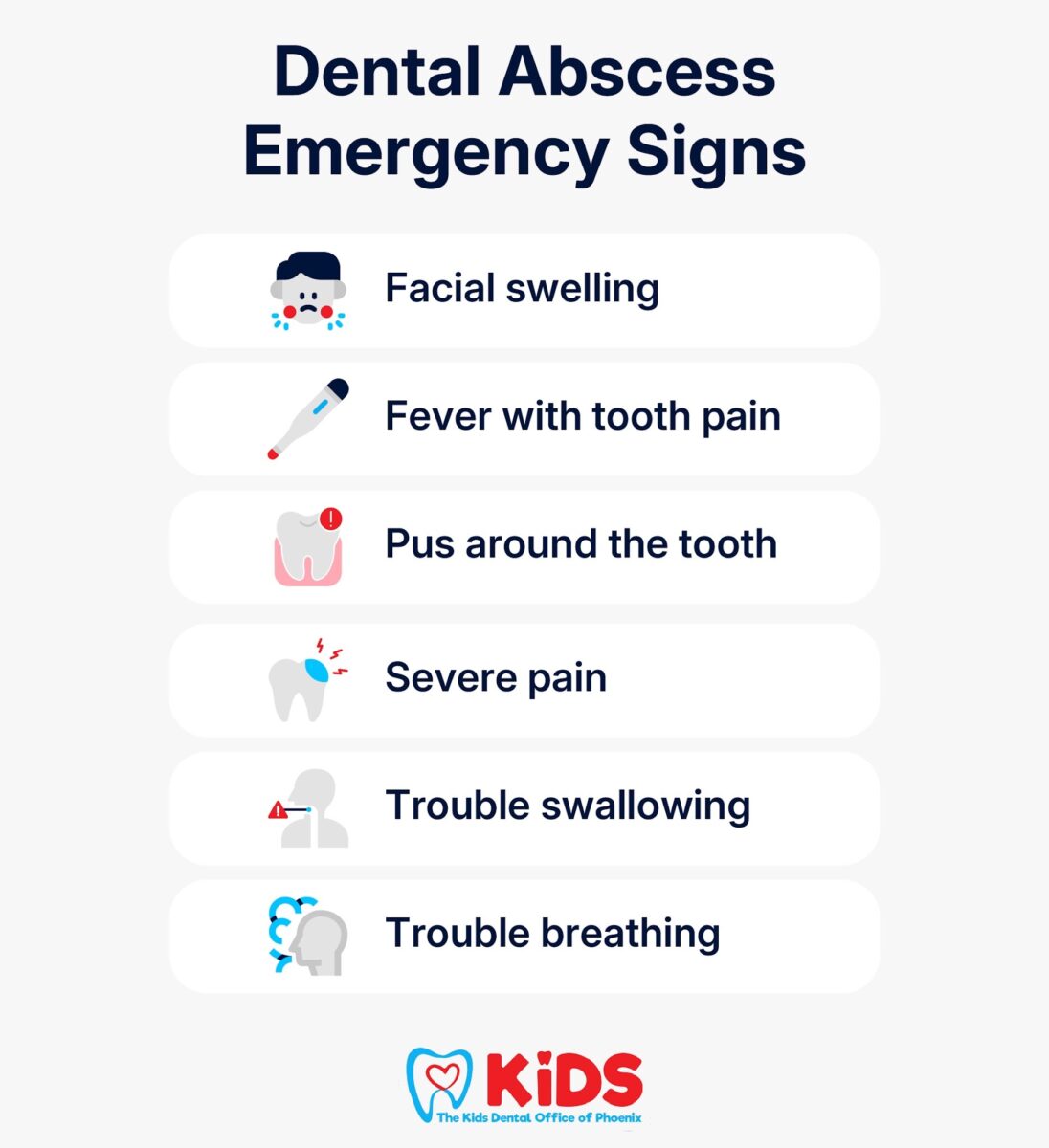
- In more severe cases, symptoms may spread beyond the mouth and include swollen lymph nodes under the jaw, fever, fatigue, and loss of appetite.
Once an abscess has formed, immediate dental treatment is necessary. The object of treatment at this point is to prevent the infection from spreading further. Specific measures include:
- Your child’s dentist will drain the abscess to remove the pus and reduce pressure (a note of caution: do not attempt this at home; you could make the infection worse by spreading it to surrounding tissues).
- Antibiotics will typically be prescribed as an integral part of treatment, along with pain medication.
- Typically an extraction will be required.
Stage Five: The Infection Spreads to Surrounding Tissue
At this point, the abscess infection has spread beyond the tooth and gum area into the face and jaw. It can enter the bloodstream and cause a serious infection known as sepsis. Symptoms now include high fever, difficulty opening the mouth, swallowing, or breathing. Your child may appear to be seriously ill, fatigued, and confused.
Stage five is a serious medical issue. At this point, the infection is no longer a matter for dental treatment, but a general health emergency. Take your child to the emergency room for immediate treatment. Hospitalization may be necessary.
Treatment at stage five often requires surgical drainage of the infection and intravenous administration of antibiotics. In severe cases, breathing assistance may be required. Only after the general systemic infection is addressed can your dentist or an oral surgeon treat the infected tooth with a root canal or tooth extraction.
What You Can Do Right Away if You Suspect Your Child Has a Tooth Abscess
If you believe your child has a tooth abscess, do not treat it at home. Call Kids’ Dental Office of Phoenix to schedule an appointment as soon as possible.
Dental treatment is required to treat a dental abscess, but there are some immediate home remedies you can take to reduce your child’s symptoms before getting to a pediatric dentist:
- You can give your child an over-the-counter pain relief medicine like acetaminophen or ibuprofen (not aspirin).
- A cold compress, such as an ice pack, applied to the outside of the cheek can help reduce swelling.
- If your child is old enough to follow instructions not to swallow it, a gentle, warm, salt-water rinse of ½ teaspoon of salt in a cup of warm water can help cleanse the area around the infected tooth and soothe the gums.
- Stay calm and comfort your child. Your calm voice and your presence will help ease his or her fear until you can get to the dentist for treatment.
How to Prevent a Child Dental Abscess
Prevention is the best treatment of all.
Most dental abscesses are entirely preventable with consistent oral hygiene at home and regular checkups with your child’s dentist. The earlier you catch a problem in the tooth decay process, the simpler the treatment — and the lower the chance your child will ever know what an abscess feels like.
Here is what we recommend to parents:
- Brushing twice a day. Use a soft-bristled brush and a small amount of fluoride toothpaste appropriate for your child’s age. Younger children will need a parent’s help with brushing until they have the dexterity to do a thorough job on their own, usually around age 7 or 8.
- Flossing once a day. As soon as two of your child’s teeth touch each other, flossing becomes important to remove plaque from between the teeth. Plan on helping younger children with flossing.
- Limiting sugary snacks and drinks. Sugar feeds the bacteria that form plaque, and plaque initiates the enamel-decay process described in Stage One above. Water is always the best beverage choice between meals.
- Regular checkups every 6 months. Bring your child in for a routine dental check-up and cleaning at least twice a year. This is when we can spot early-stage decay before it becomes a cavity, let alone an abscess.
- Fluoride treatments. Professional fluoride applications strengthen your child’s tooth enamel and help defend it against decay.
- Dental sealants. Sealants are a thin protective coating applied to the chewing surface of your child’s back teeth. They prevent food and plaque from settling into the deep grooves of the molars, where most cavities start.
Preventive care is the easiest and least stressful way to keep your child’s smile healthy, and it is also the most affordable, especially if Medicaid covers your family.
Do You Need Help With the Cost of Dental Treatment?
One of the most agonizing experiences you can have as a parent is to watch your child suffer and think there is nothing you can do about it. It is an unfortunate fact that many parents with limited household income may feel they cannot afford to take their children to the dentist, so they may forgo preventive pediatric dental care that can prevent a tooth abscess before it starts.
If your household has a limited income, there is no reason why you cannot take your children to the dentist. The federal government and the state of Arizona have partnership programs in place that provide no-cost or low-cost insurance through federal Medicaid or the Children’s Health Insurance Program (CHIP).
Medicaid Coverage for a Dental Abscess
Federal Medicaid assistance is available for qualifying households through the Arizona Health Care Cost Containment System (AHCCCS). If AHCCCS covers your household, your child can receive comprehensive dental care (check-ups, cleanings, fillings, and emergency dental care) at no cost to you, up to age 21 under the Early and Periodic Screening, Diagnostic, and Treatment (EPSDT) benefit.
For a child dental abscess, Medicaid coverage generally includes the exam and X-rays needed to diagnose the problem, treatment to relieve pain and infection (such as drainage of an abscess, a baby root canal, or tooth extraction if needed), medications like antibiotics or pain relief prescriptions, and even hospital care if an infection gets to stage five.
Arizona Medicaid covers these emergency dental services with no copay for children up to age 21.
The CHIP Program
If you cannot qualify for Medicaid benefits, but still have a low income, Arizona administers federal CHIP benefits through the KidsCare program. KidsCare offers affordable insurance that covers routine and medically necessary dental care for children.
The bottom line is this: parents who wait until a child has reached the stage of tooth abscesses when tooth decay has worsened into an abscess almost always do so because they think they can’t afford to pay for a dentist.
Don’t let this happen to you, or to your child. Help is available. Call Kids’ Dental Office of Phoenix to find out more if a tight budget is keeping you from bringing your child to the dentist.
Do You Need More Information About Tooth Abscess Treatment for Your Child?
At the Kids’ Dental Office of Phoenix, our pediatric dentists provide a full range of dental services for children. When you bring your child to us for regular dental check-ups and teeth cleanings, chances are your child will never have to know what it is like to experience the pain of a tooth abscess.
To speak with one of our skilled child dentists, call our office at (602) 903-4894 or use our online contact form.
Frequently Asked Questions (FAQ) for Parents
It’s just a baby tooth that’s abscessed. Do we really need to treat it if it will fall out anyway?
Yes, treat it promptly. Even though baby teeth do eventually fall out, an abscess in a baby tooth can cause serious pain and infection now and may damage the developing adult tooth underneath. The infection can also spread or harm your child’s overall health. A dentist will treat the tooth or remove it safely. This protects your child and his or her future smile. Don’t wait for the tooth to fall out on its own if it’s infected.
Will my child need antibiotics for a tooth abscess?
Possibly, but antibiotics alone are not enough. For a tooth abscess, dentists typically prescribe antibiotics to control the infection and prevent its spread, especially if there’s swelling or fever. However, the tooth still needs to be treated with a filling, pulpotomy, or extraction. Antibiotics can help your child feel better temporarily, but without treating the tooth, the abscess will recur.
My child has a fever and a swollen face from a toothache. Is this an emergency?
Yes. A fever and noticeable facial swelling, such as puffy cheeks or swelling around the eye or jaw, are signs that the infection may be spreading. Seek care immediately. If you can’t reach a dentist right away, take your child to an urgent care or emergency room. For milder symptoms, such as pain without fever or a small gum pimple, a prompt dentist visit is usually enough. When in doubt, err on the side of caution and get medical help.
Can my child go to school with a tooth abscess?
If your child is in pain or has swelling or a fever, it is best to keep him or her home and see a dentist. A dental abscess is an infection that needs treatment, and your child might not be able to concentrate at school. After starting treatment, your dentist will let you know when your child can resume normal activities.
Does Medicaid cover treatment for my child’s abscessed tooth?
Yes, in most cases. Medicaid through AHCCCS in Arizona covers emergency dental services for children, including treatment of dental infections and abscesses. This means the dental exam, necessary X-rays, the treatment, and any needed medicines should be covered. Be sure to visit a Medicaid-enrolled pediatric dentist, such as the Kids’ Dental Office of Phoenix. If you’re unsure, call your Medicaid plan’s member services to find a dentist who takes your coverage.