
An avulsed tooth is a tooth that has been completely knocked out of its socket. Never replant a baby tooth. For a permanent tooth, handle it by the crown and gently rinse it if it’s dirty. Reinsert it immediately only when safe and appropriate. If you cannot reinsert it, keep it in milk. Seek emergency dental care immediately.
Act immediately; do not wait for a 30- or 60-minute window. A permanent tooth’s chance of survival decreases as it stays out of the socket, especially if it dries out. Even after a delay, bring the tooth and seek an urgent dental assessment.
At the Kids Dental Office of Phoenix, we have prepared this guide to outline the steps you should take to treat an avulsed tooth condition. Our office accepts emergency dental appointments 24 hours a day, 7 days a week.
Call us at (602) 903-4894 to schedule an emergency appointment with one of our experienced child dentists.
Remain Calm and Act Quickly
If your child has a tooth that has been completely knocked out, the first step is determining whether it is a baby (primary) tooth or a permanent tooth. The recommended treatment is very different.
If a BABY Tooth Is Knocked Out, Do Not Put It Back In
The tooth may be a BABY (primary) tooth if:
- Your child is younger than 6 years old.
- The tooth is smaller and appears to be a brighter white.
- It came from an area where adult teeth have not yet erupted.
A knocked-out baby tooth should not be replanted. Replanting it can potentially damage the developing permanent tooth underneath the gums.
What To Do
- Keep your child calm.
- Have him or her bite gently on clean gauze or a clean cloth to control bleeding.
- Apply a cold compress to the outside of the face if swelling develops.
- Contact the Kids Dental Office of Phoenix promptly for an examination.
Even when a baby tooth is not replanted, a dental evaluation is important to check for injuries to the gums, surrounding teeth, lips, or jaw.
If a PERMANENT Tooth Is Knocked Out
The tooth may be a PERMANENT tooth if:
- Your child is age 6 or older.
- The tooth is larger and may appear slightly darker or more yellow than baby teeth.
- It is one of the front adult teeth that erupted after a baby tooth was lost.
Age and appearance are clues, not a reliable diagnosis; children can have both baby and permanent teeth. If you are unsure, do not force the tooth back in. Keep it moist in milk and get immediate guidance from a dentist.
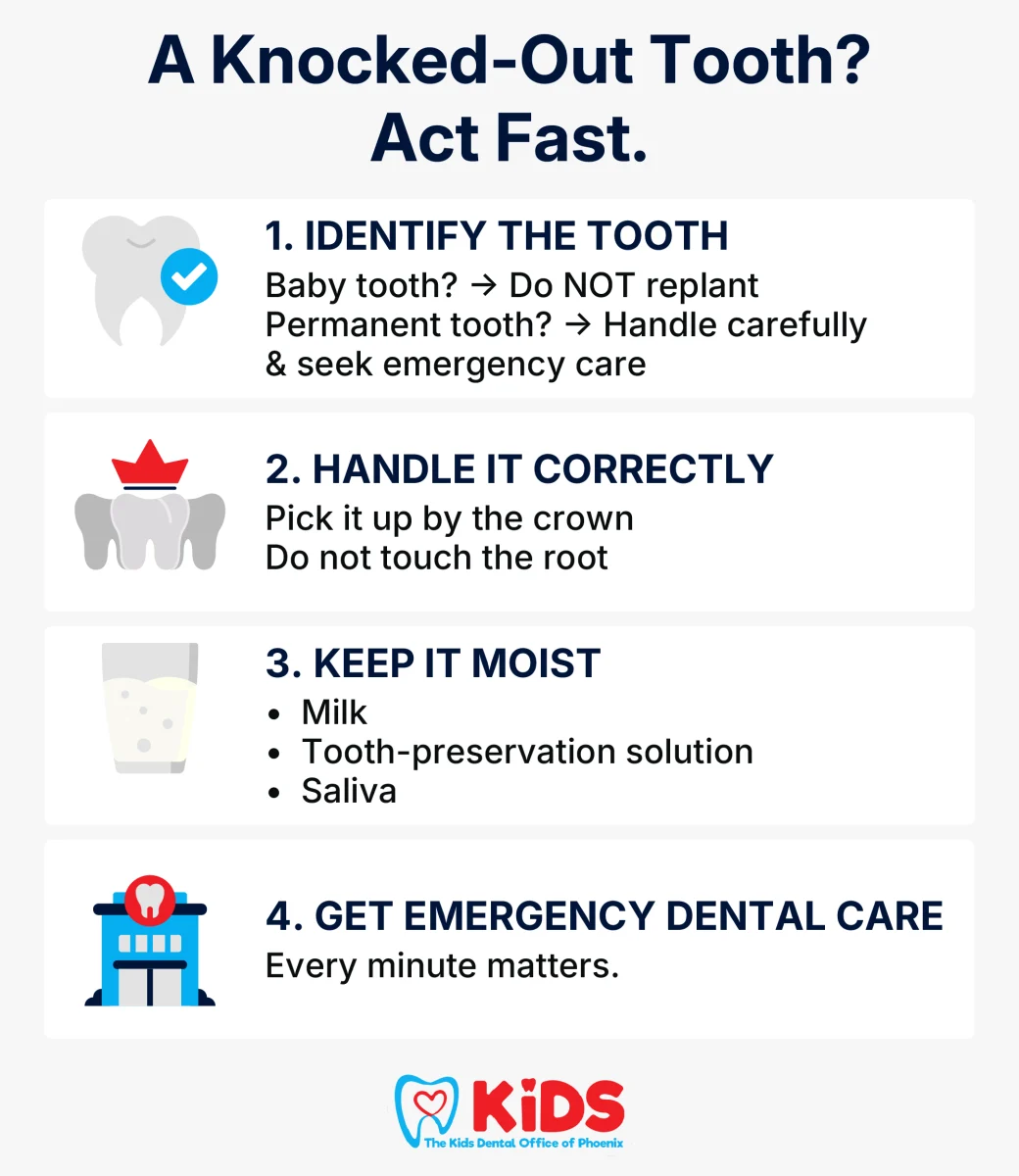
Every Minute Counts
A permanent tooth has the best chance of being saved when treatment occurs as quickly as possible.
Step 1: Find the Tooth
- Pick up the tooth by the crown (the part normally visible in the mouth).
- Avoid touching the root.
Step 2: If the Tooth Is Dirty
- Gently rinse the tooth with clean water or milk.
- Rinse the tooth only briefly.
- Do not scrub, brush, scrape, or disinfect the tooth.
Step 3: Reinsert the Tooth When Appropriate and Safe
Only attempt this procedure for a tooth you know is permanent, when your child is alert and cooperative, and there is no risk of choking or swallowing it:
- Gently push the tooth back into its socket.
- Make sure it is facing the right direction.
- Have your child bite gently on gauze to help hold it in place.
Step 4: If Reinsertion Is Not Possible
Keep the tooth moist. Suitable storage options include:
- Cold milk
- A tooth-preservation solution, if available
- Your child’s saliva in a clean container
Do not let the tooth dry out.
Step 5: Seek Emergency Dental Care Immediately
Call and head to The Kids Dental Office of Phoenix as soon as possible.
Bring the tooth with you.
If the Tooth Is Loose or Partially Displaced
Sometimes a tooth is not completely knocked out but has been:
- Pushed inward or outward
- Moved sideways
- Left noticeably loose
What You Should Do
- Avoid forcing the tooth into position.
- Do not wiggle or test it repeatedly.
- Have your child bite gently on gauze if needed.
- Contact the Kids Dental Office of Phoenix immediately for an urgent evaluation.
Prompt care can improve the chance of saving and stabilizing the tooth.
What To Do About Bleeding
Some bleeding is normal after a dental injury.
To Control Bleeding
- Place clean gauze over the area.
- Apply gentle, steady pressure.
- Replace gauze as needed.
- Use a cold compress on the outside of the face to help reduce swelling.
If the bleeding is severe, does not slow with pressure, or your child may have a more serious injury, then seek immediate emergency room treatment.
Why Speed Matters
For a knocked-out permanent tooth, time is critical.
The cells on the tooth’s root surface begin to lose viability once the tooth is out of the mouth, especially if it dries out. The faster the tooth is properly handled and your child receives professional care, the greater the likelihood the tooth can be successfully preserved.
What the Dentist May Do Next
After evaluating your child, the dentist may:
- Examine the injured tooth and surrounding affected areas
- Take dental X-rays
- Reposition an injured tooth if necessary
- Splint the tooth by attaching it to neighboring teeth for stability while healing occurs
- Monitor the tooth’s healing over time
- Schedule follow-up visits to check the tooth, bone, and supporting blood vessels and gum tissue
Follow-up treatment is important because some complications may develop weeks or months after the injury.
Emergency Pediatric Dental Care in Phoenix
A knocked-out tooth is a true dental emergency. Whether the injury involves a baby tooth, a permanent tooth, or you are unsure which it is, contact the Kids Dental Office of Phoenix immediately at (602) 903-4894 for guidance and emergency pediatric dental care.
Remember:
- If a baby tooth is knocked out, do NOT replant it.
- If a permanent tooth is knocked out, handle it by the crown, rinse it gently if dirty, keep it moist, reinsert it when safe, and seek emergency care immediately.
- If you’re unsure, call The Kids Dental Office of Phoenix right away.
What Will My Child’s Dentist Do for a Knocked-Out Tooth?
The process for putting an avulsed tooth back into the socket varies depending on the severity of the injury to your child’s gums and how long the tooth was out of the mouth. For example, if the tooth is broken, reimplantation can be more complicated.
The most important thing for a successful reimplantation is to get it done as soon as possible, ideally immediately after the injury, when safe.
First, one of our pediatric dentists will use sterile saline to flush debris from the socket.
The dentist may gently replant the permanent tooth and stabilize it with a passive, flexible splint, usually for about two weeks. Associated bone injuries can require a longer splinting period.
Healing depends on root maturity, dry time, storage, and the surrounding injuries. The dentist will monitor the ligament and bone around the tooth and watch for infection, root resorption, or ankylosis. Root canal treatment may be needed, depending on the tooth’s development and response.
Follow-up begins early, often at two weeks and four weeks, then at three months, six months, one year, and annually for at least five years. Immature permanent teeth may need additional checks; follow the dentist’s individual schedule.
When Is Replantation Not Possible, and What Are the Next Steps?
Replantation may not be appropriate in some cases, but a dentist must assess each case individually. Factors considered include:
- Severe tooth decay or advanced gum disease that affects whether the tooth can be saved
- The child’s medical history and ability to undergo treatment safely
- Time out of the mouth and storage conditions, which affect prognosis but do not automatically rule out replantation
Even after a long delay, a dentist may replant a permanent tooth temporarily to preserve appearance, function, and the surrounding bone. If the tooth cannot be saved, a pediatric dentist and orthodontist can plan a replacement or space management suited to your child’s age and development.
Dental Implants
Dental implants replace missing tooth roots surgically, but they are generally deferred until jaw growth is complete. Early placement can leave an implant out of alignment as neighboring teeth and the jaw continue developing.
While your child is growing, a temporary replacement or orthodontic space management may be more appropriate. Same-day implant crowns are not a routine, immediate solution after a child’s tooth is knocked out.
If an implant is considered later, a specialist will assess growth, the available bone, and oral health. Implant placement, healing, and the final crown are planned individually.
Dental Bridges
A resin-bonded bridge may be an option for some children or adolescents. It supports a replacement tooth by bonding to a neighboring tooth, usually with little or no drilling. A conventional bridge that requires crowns on adjacent teeth is a different treatment. Suitability depends on the bite, supporting teeth, growth, and the overall plan.
Dentures
A removable partial denture can temporarily replace one or more missing teeth. Your child’s dentist will assess whether it is appropriate for their age and dental development and explain the cleaning and follow-up. The appliance may need adjustment or replacement as the mouth changes; comfort and cost vary.
Do You Have Questions About Avulsed Tooth Treatment Options?
If your child has experienced a knocked-out tooth, the pediatric dentists at The Kids Dental Office of Phoenix can answer your questions about the best long-term treatment options for your child. Call our dental office at (602) 903-4894 to schedule a dental appointment for your child.